Wrecked and Weird: Florida Keys
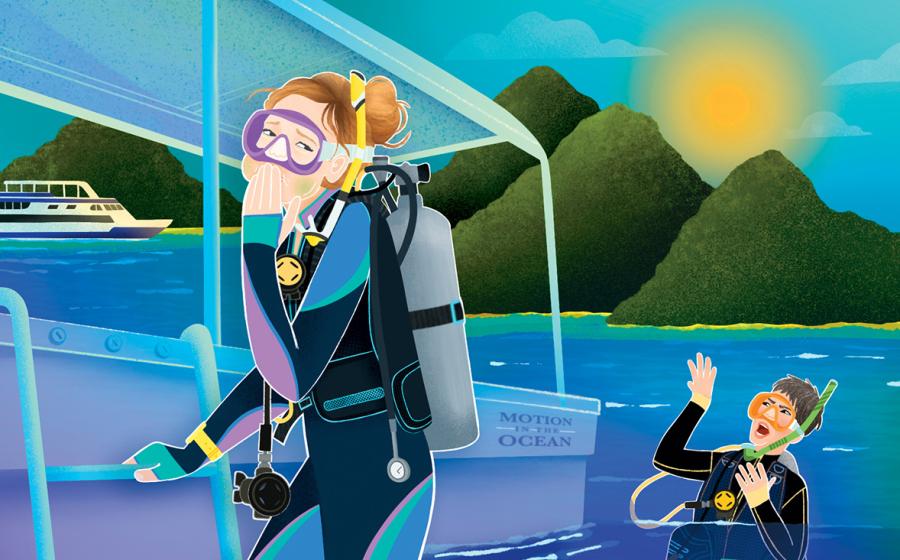
As I glide over a healthy finger of reef, "Under the Sea" a song from The Little Mermaid is playing all around me. Descending to a sand flat, I wait for an appropriate spot in the music, raise a trumpetfish to my lips and sound a single burbling note. A bespectacled Elton John applauds my effort. So does Marilyn Monroe, but only momentarily, because her signature white skirt is floating up around her waist again. Then I pass the trumpetfish to a mermaid, who mimics my efforts and blows me a kiss.
A CONCERT SIX MILES OFFSHORE
No, I am not having a bad shellfish reaction. It is mid-July, and I'm taking part in the annual Underwater Music Festival at Looe Key. For this event, US-1 Radio (WCNK) plays nothing but underwater-, ocean- and Keys-themed music for five straight hours, and area dive boats drop specially designed speakers into the water so snorkelers and divers can listen while they tour the reef. Volunteer performers don costumes along with their dive gear, so they can do impressions of rock stars and Hollywood idols. Artwork hangs on weighted frames so sergeant majors, barracuda and scuba divers can swing by and inspect original prints that will be auctioned off later in the week to help support the event.
And the trumpetfish? It's an original, metal sculpture by local artist August Powers, who has created at least one marine-themed instrument from a "manta mandolin" to a "sax-eel-phone" for every Festival in the past half-decade.
www.sportdiver.com/floridakeys
The festival was dreamed up by the local radio station in 1984 to help promote visits to the Keys and, in particular, the Looe Key National Marine Sanctuary. To say it has succeeded is an understatement. On this beautiful, blue-sky morning, every mooring ball on the reef is occupied, and some have strings of three or more boats drifting leeward behind them. Snorkelers are swimming from boat to boat to greet neighbors and to see what the seagoing tailgaters have cooking on their grills. In addition to Old Glory, some vessels are flying Conch Republic or the skull-and-crossbones flag. One even has a pirate at the helm, complete with a tricorn hat, waistcoat and cutlass. Everyone is having a great time in seas so calm that even some newly certified festival-goers are having no problem getting in an hour of bottom time. When I'm invited to sound the first underwater note ever played on Powers' centerpiece instrument, I feel as if I've lived here all my life.
THE 1½ HP MARGARITA
I feel that way even more several hours later as some friends and I walk into Boondocks Bar and Grill. By day, this Ramrod Key landmark gets its share of vacationers trying their luck at the miniature golf course next door. But when the sun goes down, locals tend to predominate. We've only just walked in when we're greeted by the model diver who was playing Marilyn Monroe at the festival. As we're seated at our table, Dr. Dave Vaughan, a marine biologist we'd met a few days before at the Florida Keys Eco-Discovery Center, stops by with his wife and chats about diving. Right after that, a local dive operator swings by to say hello. It's old home week.
There's a reason for the standing-room-only crowd on this particular Saturday night: Howard Livingston and the Mile Marker 24 band a group that plays just enough Jimmy Buffett cover tunes to keep the tourists happy, plus a large list of original music that has cinched their reputation as the best band in the Keys is in the house. They're so good that they have their own international fan club (coconutcastawaysiowa.com).
At Dr. Vaughan's urging, I head to the dance floor at the beginning of the second set and watch as the band wheels out its venerable traveling icon: a 1952 Johnson 1.5 horsepower outboard motor that has been lovingly restored and converted to a blender. With much ceremony and a microphone held to the contraption to show that it is, indeed, an operating outboard motor, the proper ingredients are added with a bunch of ice. Several clouds of green froth later, and the band whips up margaritas for everyone within walking distance of the stage.
www.sportdiver.com/floridakeys
AUDUBON SLEPT HERE
Now, don't get me wrong. The Florida Keys and Key West are not all wacky ideas and booze-in-a-blender. It is perfectly possible to have a traditional, educational or even tranquil trip here. Ernest Hemingway and Tennessee Williams both lived here, making it one of the great literary destinations. In Key West, you can visit the cottage where John James Audubon did much of the work for his book, Birds of America. And between the "Little White House" in Truman Annex on the old Navy yard and the new Florida Keys Eco-Discovery Center (a joint project of the National Oceanic and Atmospheric Administration, Mote Marine Laboratory and other state and federal agencies), there is plenty of grist for a wholesome family vacation.
Still, this is the only island destination I can think of that has a clothing-optional bar in the center of its tourist district. And this is no recent phenomenon "strange" has a long tradition in these drive-to islands. On April 23, 1982, in protest of a border-patrol station that had been established in Florida City on the mainland just north of the Keys (requiring Monroe County residents to show proof of citizenship in order to come and go), the mayor of Key West seceded from the Union on behalf of all of the Keys and announced the establishment of the Conch Republic, an independent and sovereign state. Then, 60 glorious and emancipated seconds later, he surrendered the infant republic to the commander of the Key West Naval Air Station and, as leader of a vanquished nation, requested $1 billion in federal assistance.
Weirdness, it seems, grows wild here. Everywhere I go in the Florida Keys, I comment on that. Not once do I get an argument; most Conchs seem to revel in their Bizarro-World rep.
WELCOME HOME
Fortunately, weirdness and scuba diving seem to enjoy a tightly symbiotic relationship. That makes America's southernmost archipelago one of those places where a diver can feel perfectly, and instantly, at ease.
Divers have long known the Keys as North America's northernmost coral reef. Sombrero Reef, Molasses Reef and American Shoal (and more Molasses, and more Sombrero) are on most travelers' must-dive lists. Here, tropical fish normally found considerably farther south abound and especially in the Upper Keys waters are kept beautifully clear by the nearness of the Gulf Stream. But a second draw and for many divers the central reason to travel to the Keys is the great variety of natural and artificial shipwrecks.
www.sportdiver.com/floridakeys
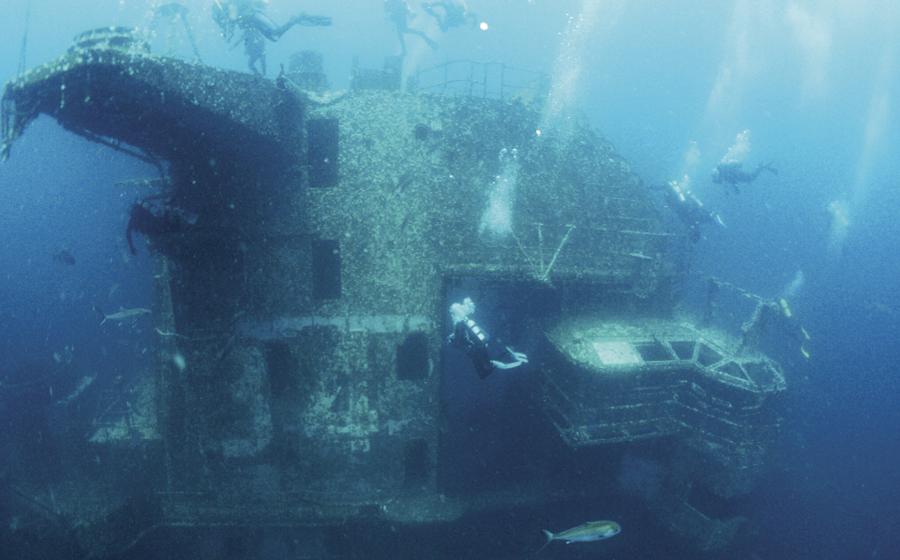
We discover this the moment we drop in on the Adolphus Busch Sr., a 210-foot former interisland freighter renamed after the brewing magnate (whose family assisted in its sinking) and set on a 100-foot bottom not far from Looe Key in 1998. Throughout the years, the Busch has settled a bit, making it possible to achieve 105 feet or more if one descends to the bottom of its holds.
As our dive boat is tied off to the old freighter's bow and the current is running steadily from there to the wreck's stern, my dive buddy and I cruise its railings in the most effortless method imaginable. Letting the current push us as we hover, we burn perhaps 25 psi of air on our journey back to the freighter's already encrusted superstructure. Once we reach it, our adventure turns into a mini wall dive as we ascend several feet of overgrown, vertical steel plate. Then we drift through open hatchways into the bridge and begin to make our way down, going deeper and deeper into shadow, but never quite away from the light as we pass down through the superstructure, through an empty engine room and finally to a lower level where the steering gear still sits, intact.
As we begin to make our way back forward, I see something move in the darkness. I switch on my dive light and am greeted by the hulking, gape-mouthed visage of a goliath grouper as wide across as a small-block V8, and several hundred pounds if he's an ounce.
Mr. Big exits forward in a hurry which, for a goliath grouper, is a speed somewhere slightly above a crawl. When he realizes that we are headed in the same direction, he moves to the side, and I watch a fairly large porthole slide into total eclipse as he passes before it.
Ahead of me, my buddy checks his air before pulling and gliding through a large opening into the cavernous hold. Instantly, I figure out what he's up to we'll go back through the bowels of the ship and avoid the headwind of current on our trip forward to the line.
www.sportdiver.com/floridakeys
We travel this way for two or three minutes. Then we come to a bulkhead, where I raise my hands above my head, Superman-style, so I can squeeze through a small, square hatchway in the deck above. After I'm out, I glance back and see a small, pivoting eye in a giant, marbled face it's the grouper, who has followed us, doglike, through the wreck.
RAMROD REVERIE
Dinner that night is at Parrotdise Waterfront Bar and Grille, a place on Ramrod Key that you can drive or boat to and another gathering spot known for its music. The house has its own wines a Chardonnay and a Cab and I'm skeptical at first, because Florida is not a state known for producing dry wines. Then the owner comes by, offers me a taste and explains that his son owns the vineyard, which is in California. The parrot-themed label looks distinctly Keys-ish, so I get a couple of bottles, intending to take them home. But some friends from Miami come by and sit at our table, so during the next hour, the wine is converted to memories.
In the morning, we head east and stop in Marathon at The Turtle Hospital Florida's only state-certified veterinary facility for sea turtles. It was started in the 1980s by Richie Moretti, a former VW mechanic from Orlando, who still looks like the VW mechanic everybody trusted in the '70s, complete with the chillin' attitude and long ponytail. Retiring to the Keys, he bought the Hidden Harbor Motel and, on seeing that the former owner had kept tarpon in the old, saltwater swimming pool, started wondering what else could live in there. Soon the pool was a recovery center for injured turtles.
One thing led to another. In the next 20 years, the former strip club next door was renovated into a modern medical facility, complete with a surgical suite, X-ray machine, conference center and more, and a turtle ambulance was put on 24-hour call. When the hotel was inundated by Hurricane Wilma, Moretti refurbished it, but never reopened it all rooms are now used for storing hospital supplies and housing the volunteer staff. His energies are now directed entirely toward the sea turtles, about 45 of which are housed at the hospital on any given day some getting strong enough to be released, and others being lovingly looked after for the rest of their lives. The place has such a sterling reputation that a sick sea turtle was once FedExed to the hospital from New England.
WARSHIPS
We're fascinated by the turtles, which range from dinner-plate size to enormous. But, we can't stay long. We are headed to the Spiegel Grove.
The Grove is a 510-foot landing-ship dock a ship with a pickup-bedlike dry dock on the back, used for launching and retrieving amphibious craft. It is unique among the Keys' shipwrecks because it is both an artificial reef and a natural shipwreck.
In 2002, the huge ship was in the final stages of being prepared for scuttling when it began to take on water. A list began to develop, and project managers decided to tow it out to the scuttling site before it sank at the dock. Eventually, the list became so bad that, once on-site, it sank to the 135-foot bottom on its side.
That wasn't what its handlers had planned, but the Grove became an instant hit with divers anyhow. I remember doing the Grove as two dives: a topsy-turvy wreck dive on one side, and a sloping "wall dive" on the other.
But the Spiegel Grove we'll dive today with PADI Dive Center Quiescence Diving Services is a totally different site. In 2005, Hurricane Dennis came through, rolling the big ship onto its keel. As we descend, a current is blowing so hard that the snappers next to us are swimming for all they're worth, wriggling frantically just to hold their place next to the mooring line. But long before we get to the wreck, I can see that it seems to be sitting perfectly level. To stay out of the current, we duck behind bulkheads and stay low, next to the deck, like bubble-blowing cruise missiles. But it is thrilling to see the ship sitting just as the plans originally had called for, half a decade ago.
www.sportdiver.com/floridakeys
The next day, we'll join PADI Dive Center Silent World to dive an older cousin the Coast Guard cutter Duane, which was sunk along with the Bibb in 1987. The Duane, whose record included service in the Mariel Boatlift in 1980, now sits upright in 120 feet of water, and has the sponges and corals earned during two decades of service as an artificial reef.
We jump in expecting a current, but the flow is so slight that I ignore the mooring line and just drift down to the wreck. Then, halfway into the dive, we can actually see the change in the water as a wisp of the Gulf Stream comes barreling through; we'll hold onto the line on the way back up.
Chris Brown, Silent World's owner, has the perfect dessert planned to follow our main course; we motor over to the Benwood, a Norwegian freighter that collided with another vessel while running blacked-out (to avoid U-boat attacks) in April 1942. Settling to a 48-foot bottom, the ship actually stuck out of the water well into the 1950s, but a combination of salvage efforts and Navy practice bombings transformed it into a half-flattened hulk.
But in the flesh or the metal, as the case may be the Benwood has wonders that go far beyond that description. Thick schools of snappers and grunts hide in every nook and cranny. Permit wheel across the deck like spinning, shiny-aluminum, garbage-can lids. As we drift along, an 8-foot nurse shark comes swimming along the convoluted deck with its hunting companion, a black grouper. Everywhere we look there is growth nearly two dozen different sorts of hard corals, more than a dozen soft corals, gorgonians and deepwater sea fans. We venture off the wreck and find a gully populated with nurse sharks and groupers; they scatter upon our arrival, but slowly venture back when we settle to the bottom and wait quietly.
IN DENIAL
It's a great dive, but it brings with it a sobering realization: We're all the way up to Key Largo now, and we're running out of Keys.
As if to postpone the inevitable, we drive 20 miles west for dinner, to Lazy Days, a stilt restaurant on the ocean side of US 1 in Islamorada and, in my estimation, the best seafood restaurant in the Keys. By midnight, we are sated on hogfish and Key lime pie.
Before we head up to Florida City and the mainland, I stop by to see an old friend, Capt. Spencer Slate, at his PADI Dive Center facility, Atlantis Dive Center.
"Wanna go see Jesus?" Slate asks.
I instantly tell him that I do.
www.sportdiver.com/floridakeys
Key Largo Dry Rocks is the site of the Keys' iconic underwater feature, the "Christ of the Deep" statue, cast from the same mold as another underwater statue near Genoa, Italy. The statue is shallow enough that snorkelers can duck down for a look, but on scuba, I have time for a close inspection. A sponge has grown on its shoulder, making it look as if Jesus is wearing a boutonnière, which to me seems appropriate.
Back at the dock, I walk around Slate's shop and look at the pictures. There's one of him officiating a wedding he invented the commercial underwater wedding and holds the world's record for both the most weddings performed underwater and the largest mass wedding ever done on scuba. There is also a photograph of him officiating at his annual charity underwater Easter-egg hunt. He is on scuba and is dressed like a
gigantic bunny, complete with the ears.
Somehow, that makes me feel better. In an hour, I'll be back on the mainland. But for right now, it's still wet, and it's still weird. So it must still be the Keys.
Special thanks to the Atlantis Dive Center (captainslate.com), Monroe County Tourism Development Council (fla-keys.com), Silent World Dive Center (silentworldkeylargo.com)
Deco Stops
Start in Key West at Mallory Square for the sunset celebration. If it's Saturday night, swing by Captain Tony's Saloon and see if he is holding court at the souvenir counter. The next morning, tour either Harry S. Truman's "Little White House" or Ernest Hemingway's Home for a slice of Keys history. And before you leave town, go into La Concha Hotel, take the elevator, press "T" (for "top") and enjoy the finest free vista in town. Walk the beach at Bahia Honda State Park, or drive some side roads on Big Pine Key in the early morning to spot Key deer. On your way up the Keys, swing by The Turtle Hospital to learn how injured sea turtles are being rehabilitated. Take a look at the area's two Wyland Whaling Walls near Mile Marker 49 and Mile Marker 100. At mile 100 on the bay side, you'll find great Cuban coffee at Denny's Latin Café. And when you leave the Keys, take Card Sound Road you'll pay a buck for the bridge toll, but the scenery is worth it.
The Guide to the Florida Keys
Average Water Temperature: 70-86°F
What to Wear: diveskin to 5 mm or 7 mm fullsuit,
Average Viz: 60-90 feet (summer-winter)
When to Go: year-round; winter has the best viz and fewest storms, while summer has the warmest water temperatures.
Must Do
Get Pie-Faced: Key lime pie, Florida's official dessert, was invented late in the 19th century at Curry Mansion Inn in Key West. Many restaurants and bakeries claim to have the best pie in the Keys; conduct your own research and see which one earns your prize.
Must Dive
Spiegel Grove: After settling onto its side after being sunk in 2002, this 510-foot Navy ship was later turned upright by a hurricane. It rests at 130 feet, but can be touched at 60.
Looe Key National Marine Sanctuary: A reef named after a British ship that struck it, Looe Key is known for the Underwater Music Festival held there each summer.
Key Largo Dry Rocks ("Christ of the Deep"): Easily the most-photographed underwater feature in the Keys, this statue can be reached easily by breath-hold diving.
Duane: Part of a brace of Coast Guard cutters sunk for divers' and anglers' enjoyment, the Duane is the most commonly dived of the two (its neighbor, the Bibb, lies on its side and is deeper).
Benwood: This open and collapsed wreck has become a fish magnet, right down to the nurse sharks that live on and near it.
Must Have
Treasure Coins: Both an investment and the ultimate bling, gold coins from the 1733 Spanish treasure fleet can be found at prices ranging from $600 to $30,000-plus. Or, do as we did, buy some "pirate coin" knock-offs from Islamorada's History of Diving Museum for $2 apiece.
Rigged & Ready
Clark Synthesis Aquasonic: Amplify your dive experience, above and below the surface, with this floating underwater stereo. clarksynthesis.com
Florida Keys Listings
Florida Keys & Key West Tourism
fla-keys.com/diving
Florida Tourism
visitflorida.com
UKADSO (Upper Keys Association of Dive & Snorkel Operators)
divecapital.org
Dive Centers
Captain's Corner Dive Center
captainscorner.com
Captain Hook's Dive Center
captainhooks.com
Captain Slate's Atlantis Dive Center
captainslate.com
Conch Republic Divers
dive@conchrepublicdivers.com
Dive Key West
divekeywest.com
Florida Keys Dive Center
floridakeysdivectr.com
John Pennekamp Coral Reef State Park
pennekamppark.com
Holiday Isle Dive Center
diveholidayisle.com
Horizon Divers
horizondivers.com
It's a Dive
itsadive.com
Ocean Divers
oceandivers.com
Rainbow Reef Dive Center
rainbowreef.us
Sea Dwellers Dive Center
sea-dwellers.com
Silent World Dive Center
silentworldkeylargo.com
Southpoint Divers
southpointdivers.com
Subtropic Dive Center
subtropic.com
Dive Resorts/Hotels
Amy Slates' Amoray Dive Resort
amoray.com
Key Largo Resorts
keylargoresorts.net
Looe Key Reef Resort & Dive Center
diveflakeys.com